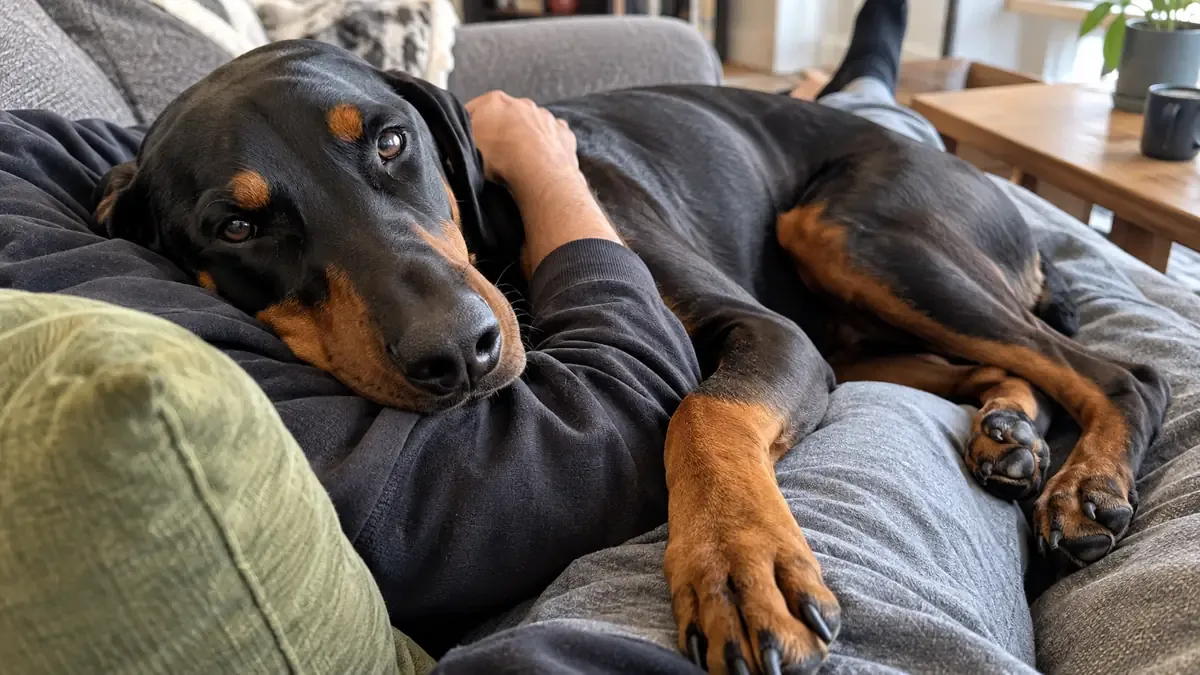
You finally sit down.
Your dog notices.
Thirty seconds later, there is a paw across your stomach, a head on your chest and considerably less room than you remember having.
If your dog is small, this may be charming.
If your dog weighs 35 kilograms, it can feel more like being slowly pinned beneath a warm, snoring sandbag.
So why does my dog lay on top of me?
Usually, there is no single hidden meaning. Your dog may be looking for warmth, physical comfort, attention or closeness. Lying on you may simply have become a familiar resting habit. Some dogs also seek more contact when they are uncertain or stressed.
And occasionally, what looks like cuddling needs a closer look — particularly if the dog becomes tense, growls or tries to stop other people or animals from approaching you.
The position is only one clue.
What your dog does around it tells you much more.
Why Does My Dog Lay on Top of Me? What It Can Mean
Start with the simplest observation:
Your dog has chosen to be physically close to you.
That is useful information, but it does not automatically tell us why.
Consider three dogs doing almost the same thing.
The first climbs onto their owner's legs every evening, sighs, closes their eyes and falls asleep.
The second jumps onto their owner five minutes before dinner, stares directly at them and keeps shifting until someone finally gets up.
The third normally sleeps alone but suddenly presses against their owner's chest during a thunderstorm.
All three dogs are lying on a person.
The likely context is completely different.
That is why dog behaviour makes more sense when we read several clues together rather than translating one action as if it has one fixed definition. Our broader dog body language guide follows the same principle.
1. Your dog may simply like being close to you
This is the obvious explanation, and sometimes the obvious explanation is perfectly good.
Dogs form social relationships with people, and research has found evidence that owners can function as attachment figures and a secure base for their dogs.
That does not mean every cuddle is a scientific declaration of love.
It does mean that choosing proximity to a familiar person is not surprising behaviour for a social animal with a strong relationship to that person.
You might notice your dog:
- settling against your legs while you watch television;
- placing their head across your lap;
- climbing onto you when you lie on the sofa;
- sleeping with part of their body touching yours;
- or moving from room to room and eventually resting wherever you stop.
If the dog looks loose, settles easily and could leave whenever they wanted, there may not be much more to decode.
They chose your company.
Sometimes that really is enough.
Dogs that regularly stay close in other situations may also show the same preference at rest. If yours seems to trail you through the house before eventually using you as furniture, our guide to why dogs follow their people everywhere explores that wider pattern.
2. You are warm
This reason gets considerably less romantic.
You may simply be a convenient heat source.
Imagine a small, short-coated dog on a cold evening.
There is an empty sofa cushion beside you.
There is also your warm stomach underneath a blanket.
The dog makes a decision.
You lose.
Temperature can influence where dogs choose to rest, and individual preferences vary enormously. A dog that burrows under blankets, seeks sunny patches or curls tightly into warm places may also be especially interested in lying directly against you.
You may notice the behaviour becoming more common in winter or when the room is cool.
And the reverse can happen too.
A dog that spends December glued to your legs may decide that the tiled floor is far more attractive in July.
Seasonal changes like that make warmth a much more convincing explanation than a complicated behavioural theory.
3. You may simply be comfortable
Dogs are not always subtle about choosing good sleeping spots.
Your thighs are soft.
Your stomach moves gently when you breathe.
Your arm makes a convenient headrest.
And unlike a cushion, you occasionally scratch behind the ears.
From the dog's point of view, this is a fairly competitive piece of furniture.
This is particularly obvious when the dog behaves exactly the same way with other soft surfaces.
For example, perhaps they:
- curl into piles of laundry;
- steal your pillow;
- choose the deepest sofa cushion;
- press against blankets;
- or lie across another family member when you are not available.
In that case, your emotional significance may be part of the picture, but physical comfort is probably contributing too.
4. Your dog may have learned that lying on you gets attention
Dogs are very good at noticing what works.
Suppose your dog climbs onto your lap.
You immediately look at them.
You laugh.
You stroke their chest.
You talk to them.
Perhaps you stop whatever else you were doing.
From your dog's perspective, that was an extremely successful experiment.
Next time they want interaction, why not try it again?
This does not mean the dog is scheming or manipulating you.
It means behaviour can strengthen when it reliably produces a useful outcome.
The timing often gives this away.
A dog that peacefully sleeps on you for an hour is different from one that climbs onto your chest, stares into your face, jumps down the moment you move and then runs towards the kitchen.
That second dog may have had an agenda.
We see something similar with staring. Dogs can learn that looking at a person predicts food, walks, play or attention, which is one reason our article on why dogs stare at their owners emphasises what happens immediately afterwards.
5. Lying on you may simply be part of your routine
Some behaviours start for one reason and eventually become habits.
Maybe your dog began sleeping on you as a puppy.
At three kilograms, nobody objected.
Two years later, the puppy has become a large adult dog who still seems convinced that your lap belongs in the same category as a dog bed.
Nothing dramatic has to be happening.
The sequence may simply be familiar:
You sit on the sofa.
Your dog comes over.
They climb aboard.
Everyone settles down.
Repeat that hundreds of times and it becomes part of the evening.
This is one reason I would be cautious about assigning a deep psychological meaning to a behaviour that has looked almost identical for years.
Habit is often underestimated because it is less interesting than saying the dog is protecting you from invisible danger.
But ordinary explanations count too.
6. Your dog may seek more contact when they feel uncertain
Closeness can also change with the situation.
Consider a dog that normally sleeps at the other end of the sofa but climbs directly onto their owner when fireworks begin outside.
Or a dog that presses closer in an unfamiliar hotel room.
Or one that stays unusually close after something startling happens.
In those examples, physical proximity may be part of seeking reassurance or security.
Do not diagnose anxiety from the cuddle itself.
Look for the rest of the pattern.
Is your dog also:
- panting when they are not hot?
- pacing?
- trembling?
- unable to settle?
- keeping their ears back?
- scanning the environment?
- trying to hide?
- or repeatedly checking where you are?
One behaviour rarely gives the answer on its own.
If you're unsure what several visible signals mean together, the WhiskyBark Body Language Decoder is designed around exactly that idea: observe the whole dog before trying to label the emotion.
7. Constant closeness is not automatically separation anxiety
This distinction matters because “my dog always lies on me” can quickly turn into “my dog must have separation anxiety” online.
That jump is too large.
A dog can enjoy enormous amounts of physical contact and still cope perfectly well when their owner leaves.
Separation-related distress is about what happens around separation.
The Merck Veterinary Manual describes signs that can include vocalising, pacing, heightened vigilance and other distress behaviours around or after an owner's departure.
So compare these two dogs.
Dog A: spends the evening lying across your legs, then watches you leave for work the next morning and goes to sleep.
Dog B: stays physically attached whenever you are home, begins pacing when you pick up your keys, vocalises after you leave and struggles to settle during absences.
The first dog may simply enjoy contact.
The second pattern deserves a closer look.
Being cuddly is not a diagnosis.
8. Occasionally, the important issue is guarding rather than cuddling
This is less common than ordinary closeness, but it is important because the body position can look innocent at first.
A dog lies across their owner.
Someone else approaches.
The dog's body stiffens.
They stare at the approaching person.
Perhaps they growl, bark, snap or move to block access.
Now we are no longer talking simply about a comfortable dog enjoying a nap.
Dogs can guard things they value, and veterinary behaviour resources recognise that some dogs can guard a person as well as food, objects or resting places.
The useful clue is not:
“My dog lies on me.”
It is:
“My dog tries to prevent other people or animals from approaching me.”
Those are very different behaviours.
If aggression or guarding is involved, do not deliberately provoke the dog to test the theory. Management and qualified behavioural support are safer than turning the situation into a confrontation.
Quick guide: what else is happening?
| What you notice | What may be worth considering |
|---|---|
| Your dog lies on you, sighs and falls asleep | Comfort, closeness, warmth or habit |
| They do it mostly when the room is cold | Warmth may be a major part of the attraction |
| They climb on you, stare and then head towards the door or bowl | Attention or a learned request may be involved |
| They suddenly seek contact during thunder or fireworks | They may be looking for reassurance during a stressful event |
| They lie on you but cope calmly when you leave | Closeness alone does not suggest separation anxiety |
| They stiffen or growl when someone approaches you | Possible guarding deserves attention |
| They suddenly become much clingier along with other behaviour or health changes | Look at the broader change rather than assuming it is simply affection |
Why does my dog always lay on me?
If your dog has always done it, habit and preference move higher up the list.
Some dogs are simply much more physically affectionate than others.
One will happily sleep at the far end of the room.
Another seems to believe that two centimetres of empty space between dog and human is an unacceptable design flaw.
Neither personality is automatically healthier.
Ask whether your dog can also:
- settle somewhere else;
- rest without constant interaction;
- cope when you move away;
- and remain comfortable when normal separations occur.
If they can, frequent cuddling may simply be part of who they are.
Why does my dog suddenly lay on top of me?
A sudden change is more interesting than a lifelong habit.
It still does not automatically mean something is wrong.
Perhaps the weather became colder.
You moved furniture.
Your schedule changed and you are now sitting somewhere different.
The dog discovered that lying on you earns attention.
There may be construction noise outside, visitors in the house or another temporary change making closeness more appealing.
But sudden clinginess deserves more attention when it appears alongside other changes.
For example:
- reduced appetite;
- restlessness;
- pain or reluctance to move;
- vomiting or diarrhoea;
- changes in sleep;
- confusion;
- new fearfulness;
- or a broader change in personality or routine.
In that situation, do not try to diagnose the cause from “my dog is lying on me more.”
The meaningful information is that your dog's normal behaviour has changed.
If the change is persistent or accompanied by signs of illness or discomfort, veterinary advice makes more sense than interpreting the extra cuddling as a behavioural message.
Why does my dog lay on me at night?
Night combines several reasons at once.
The house becomes quiet.
Everyone finally stops moving.
The temperature may drop.
Your dog is ready to sleep.
And there you are — warm, familiar and conveniently horizontal.
A dog that sleeps on you at night but spends plenty of time independently during the day may simply prefer that particular resting arrangement.
If your dog also likes sleeping beside you while facing away, that is not contradictory. Dogs can choose closeness in many different positions; our article on why dogs sleep with their bum facing you looks at another surprisingly common version.
Why does my dog lay on my chest?
Your chest gives a dog several things at once:
heat, physical contact, your smell, movement from breathing and — importantly — access to your face and hands.
For a small dog, it may simply be a comfortable resting place.
For a larger dog, the explanation may be equally innocent even if your ribs disagree.
Again, avoid assigning a precise emotional translation based only on position.
A relaxed dog snoozing across your chest is different from a restless dog climbing onto you repeatedly while panting and scanning the room.
Why does my dog lay on me and not my partner?
This question can become surprisingly political in a household.
It does not necessarily mean your dog has formally ranked everybody from favourite to least favourite.
Dogs can develop different routines with different people.
Perhaps you sit still longer.
Perhaps your partner moves too much.
You may use the softer blanket.
You might be the person who usually relaxes with the dog in the evening.
Or your dog may simply prefer physical contact with you while choosing your partner for walks or play.
Relationships do not have to look identical to be meaningful.
If your dog consistently chooses you for resting, it is reasonable to say they are comfortable doing so.
It is much harder to prove from that alone that you are their single “favourite person.”
Does laying on you mean your dog loves you?
It can certainly occur in a close relationship.
There is good evidence that dogs form attachment relationships with their owners, and dog-human social interaction has also been associated with oxytocin-related bonding mechanisms.
But science does not give us an equation saying:
dog on lap = love.
A dog can feel strongly attached to you and prefer sleeping beside the sofa.
Another can climb onto anybody warm enough to make a decent pillow.
The more useful evidence comes from the relationship as a whole:
- Does your dog willingly spend time near you?
- Do they seek you out in ordinary situations?
- Can they relax around you?
- Do they engage with you voluntarily?
- Can they also move away when they want to?
Those patterns tell you far more than one sleeping position.
Is it a pack or dominance behaviour?
I would not use that as the default explanation.
“Your dog is lying on you because you are the pack leader” sounds satisfyingly simple, but modern dog behaviour is poorly served by turning every social interaction into a hierarchy contest.
Your dog may be warm.
They may be comfortable.
They may want attention.
They may simply like resting close to you.
Those explanations do not require a dominance story.
Likewise, letting a relaxed dog lie on you does not automatically teach them that they outrank you.
Should you let your dog lie on top of you?
If both of you are comfortable and the behaviour is relaxed, there is usually no behavioural reason you must stop it.
You are allowed to enjoy having a dog on your lap.
You are also allowed to want your legs back.
Boundaries do not damage a healthy relationship.
If you would rather your dog settle beside you, make that alternative worthwhile.
Place a comfortable bed or blanket nearby.
Reward them for settling there.
Be consistent rather than allowing the behaviour one evening and becoming frustrated by the exact same behaviour the next.
A dog does not need unrestricted access to your torso to know you like them.
When is lying on you worth paying more attention to?
The behaviour becomes more useful to investigate when something around it changes.
Pay closer attention if your dog:
- suddenly becomes dramatically more clingy;
- cannot settle unless touching you;
- shows distress when you prepare to leave;
- paces, vocalises or becomes destructive during absences;
- stiffens, growls or snaps when somebody approaches you;
- seems painful or physically uncomfortable;
- shows confusion or other unusual behavioural changes;
- or combines the new closeness with other signs of illness.
Those situations are not evidence that lying on you is itself a problem.
They are evidence that the bigger pattern deserves attention.
So, why does your dog lay on top of you?
Maybe because they like you.
Maybe because you're warm.
Maybe because your stomach makes a better pillow than the expensive bed beside the sofa.
Maybe because climbing onto you has reliably earned attention for the last three years.
And sometimes, especially during stressful moments, your dog may be looking for extra closeness and security.
The mistake is trying to reduce all of those possibilities to one sentence.
Look at what happened immediately before your dog climbed onto you.
Watch what they do once they are there.
Notice whether they can relax, leave voluntarily and cope when you are unavailable.
And pay attention when a familiar pattern suddenly changes.
Your dog lying on you tells you that they chose proximity.
The rest of the story comes from context.
Frequently asked questions
Why does my dog always lay on me?
Your dog may simply prefer close physical contact, warmth or the comfort of resting against you. If they have always done it and can also settle independently, it may just be part of their normal personality and routine.
What does it mean when your dog lays on you?
There is no single meaning. Affection and social closeness may be involved, but warmth, comfort, habit, attention-seeking and reassurance during stressful situations can produce the same behaviour.
Why does my dog suddenly lay on me all the time?
Look for recent changes in temperature, routine, environment and stress first. If sudden clinginess persists or appears alongside pain, illness, restlessness or other behavioural changes, discuss the broader change with your veterinarian.
Why does my dog lay on my chest?
Your chest provides warmth, physical contact and a stable resting surface. Some dogs simply enjoy the position. The behaviour should be interpreted alongside the dog's overall posture and situation rather than given one fixed emotional meaning.
Why does my dog lay on me and not my partner?
Your dog may have different routines and preferences with different people. You may sit more still, provide a favourite resting spot or simply have developed the habit together. It does not necessarily prove that your dog values one person more in every situation.
Does my dog lying on me mean separation anxiety?
No. Enjoying physical closeness while you are home is not enough to diagnose separation anxiety. Separation-related distress is identified from behaviours associated with actual or anticipated separation, such as difficulty settling, vocalising, pacing or other distress around departures.
Is my dog trying to dominate me by lying on top of me?
There is no good reason to assume that ordinary relaxed cuddling is an attempt to establish dominance. Comfort, warmth, habit, attention and social closeness are more useful possibilities to consider first.
Can a dog resource guard a person?
Yes, some dogs can guard a valued person. The important signs are behaviours directed at others who approach, such as stiffening, staring, growling, barking, blocking or snapping — not simply the fact that the dog is lying on you.
Research and editorial note
Research supports the presence of attachment relationships between dogs and their owners, including evidence that owners can function as a secure base for their dogs. Research into dog-human social interaction has also identified oxytocin-related mechanisms associated with bonding and mutual gaze.
This does not mean that lying on a person has one scientifically proven emotional translation. WhiskyBark therefore treats affection, security, warmth, habit and attention as possible explanations that should be interpreted from the individual dog and situation rather than as fixed meanings.
For separation-related distress, see the Merck Veterinary Manual guidance on canine behaviour problems. For research on owner attachment and the secure-base effect, see the peer-reviewed study of secure-base behaviour in family dogs. Research on the dog-human oxytocin and gaze relationship is available through Science/PubMed. Veterinary behaviour guidance also recognises that dogs can resource guard a person as well as objects or resting spaces.


THE PACK IS TALKING
Join the conversation
Got a thought, experience, or dog story to add? We'd love to hear it.
No comments yet. Be the first to start the conversation.